The Investor Room · Seed round 2026
Novo Navis, Inc.
We build the structure in space infrastructure.
The edge of imagination.
The problem
Station builders pay by the pound to launch their structure.
What it costs to launch anything today.
Elogium gives 72% more structure for the same launch weight, and every cubic inch is stronger.
About 840 lb of Elogium does the job of a ton of aluminum. That's about 1,160 lb you never launch.
Same rocket, more station, less money.
Elogium 115,000 psi per axis at 0.058 lb/in³ with near-zero thermal expansion on all three axes; 7075-T6 aluminum 83,000 psi at 0.10 lb/in³. 2026 launch prices.
The solution
Avalon Civil Station, a supply point in orbit.
It makes fuel and building material where the missions leave from, and rents room to the people who work there.
Fuel
Methane and other biogas, grown and refined on board.
Building material
Carbon fiber from the same harvest, woven into Elogium.
Room to work
Facilities leased to researchers and manufacturers.
Supply for others
Fuel, gases and material for other stations and programs heading out.
Company and founder philosophy
What it takes to industrialize space.
Nothing off the shelf could build this station, so we built each layer ourselves.
The machine
Astra Porta™
The station needed a material no machine could make. We designed the loom from custom parts.
The material
Elogium
Astra Porta™ weaves a structure light enough to launch and strong enough to machine.
The kit
Structural kit
Building in orbit needed blocks that join any way. We designed the kit and its coupling.
The intelligence
Station AI
Assembly and operations needed an AI to run them. We built ours in-house.
Owning every layer opens every market downstream, in orbit and on Earth.
And industrialize it, we will.
The machine
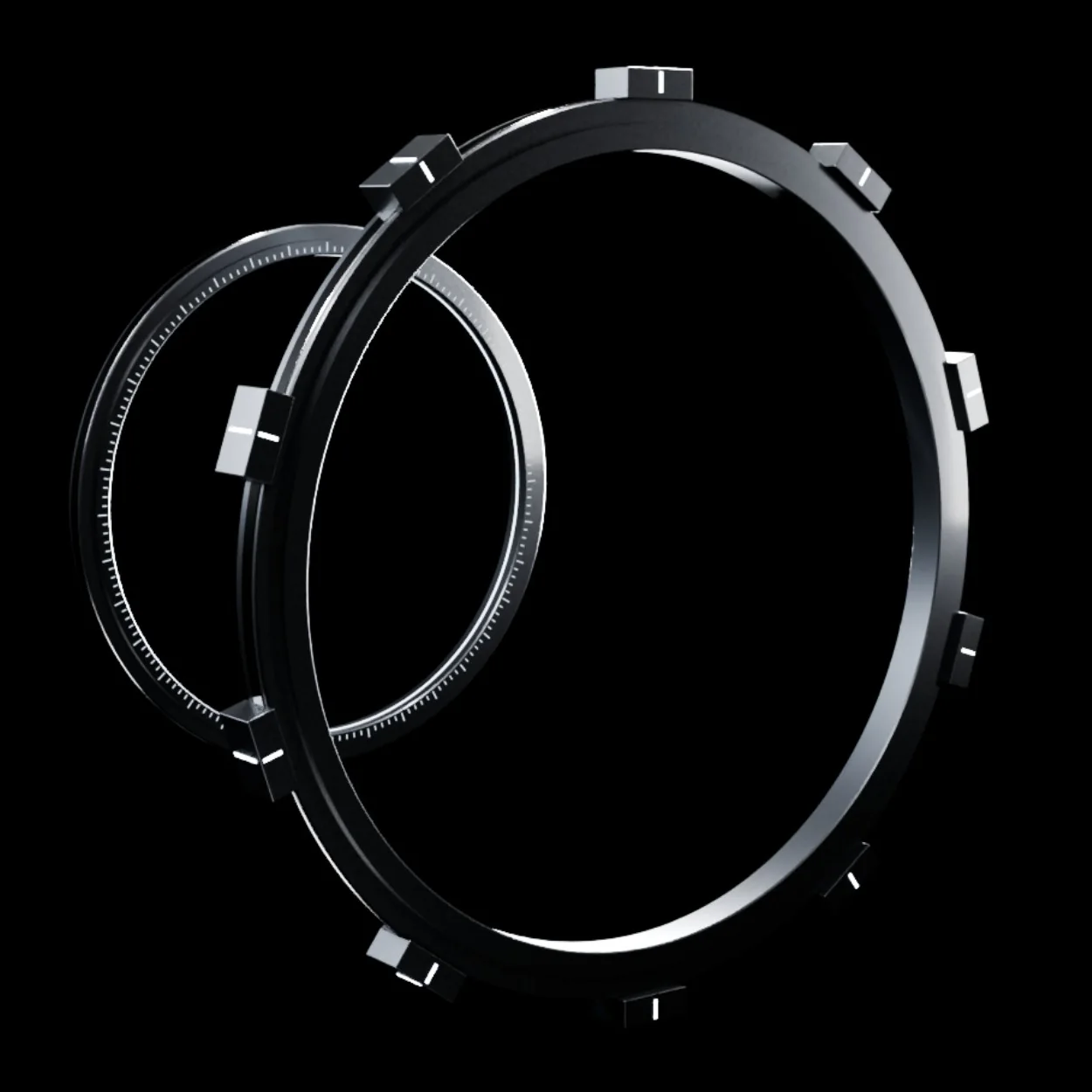
Astra Porta™
The loom that makes Elogium.
Designed in-house from custom parts. It makes Elogium for the station, and for aerospace and defense on Earth. Its Critical Design Review is Milestone 0 of this raise, and building it is Milestone 1.
The breakthrough
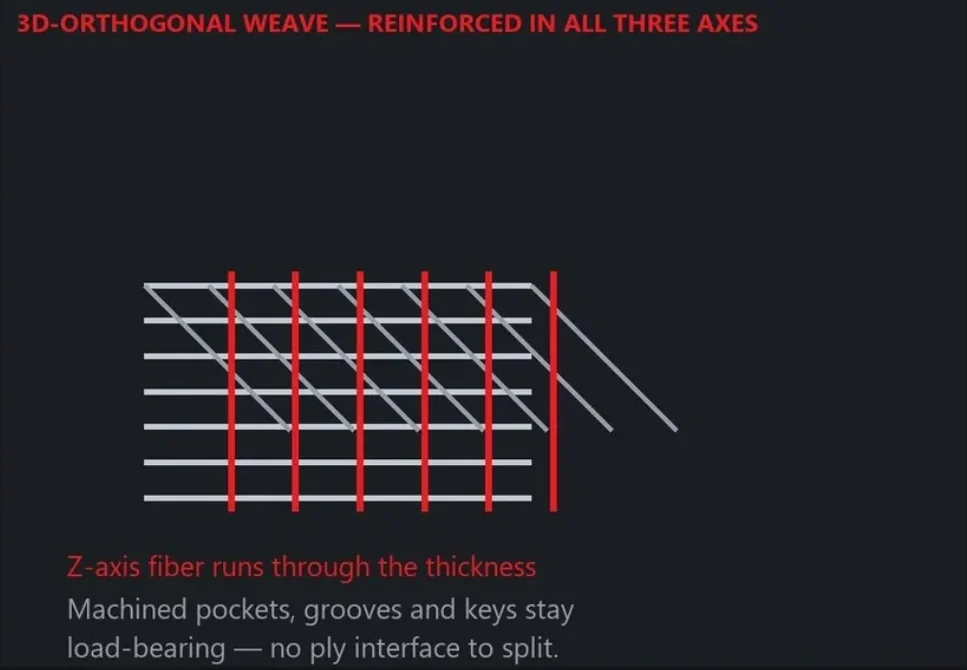
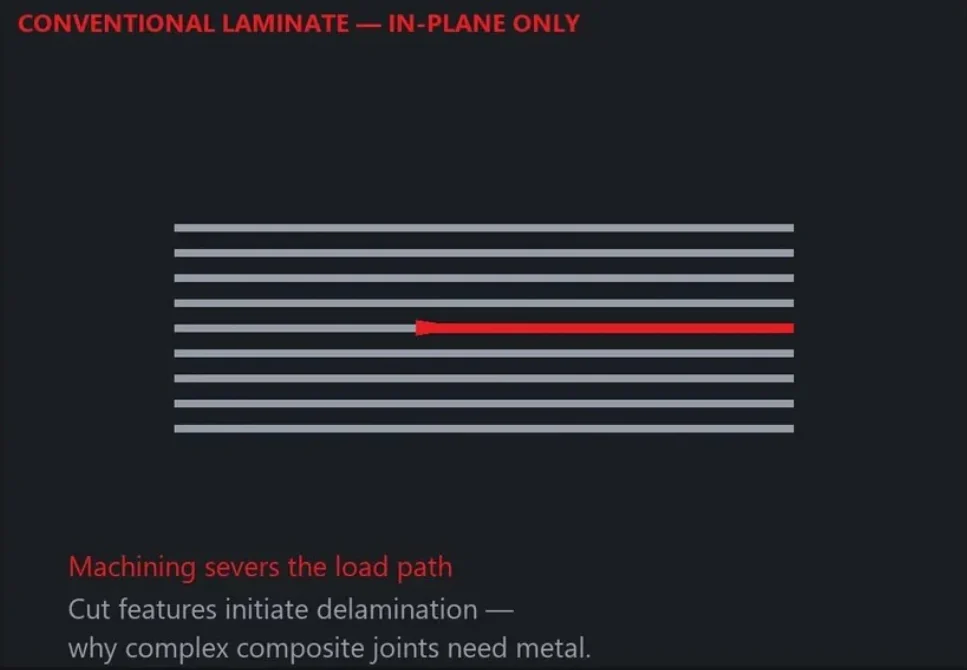
Elogium machines like metal.
Carbon fiber woven in three directions at once, packed tight. Pockets, grooves and threads cut straight into the block stay load-bearing.
The weave scales: for the station, and for aerospace and defense on Earth.
The kit
Elogium Reconfigurable Structural Kit
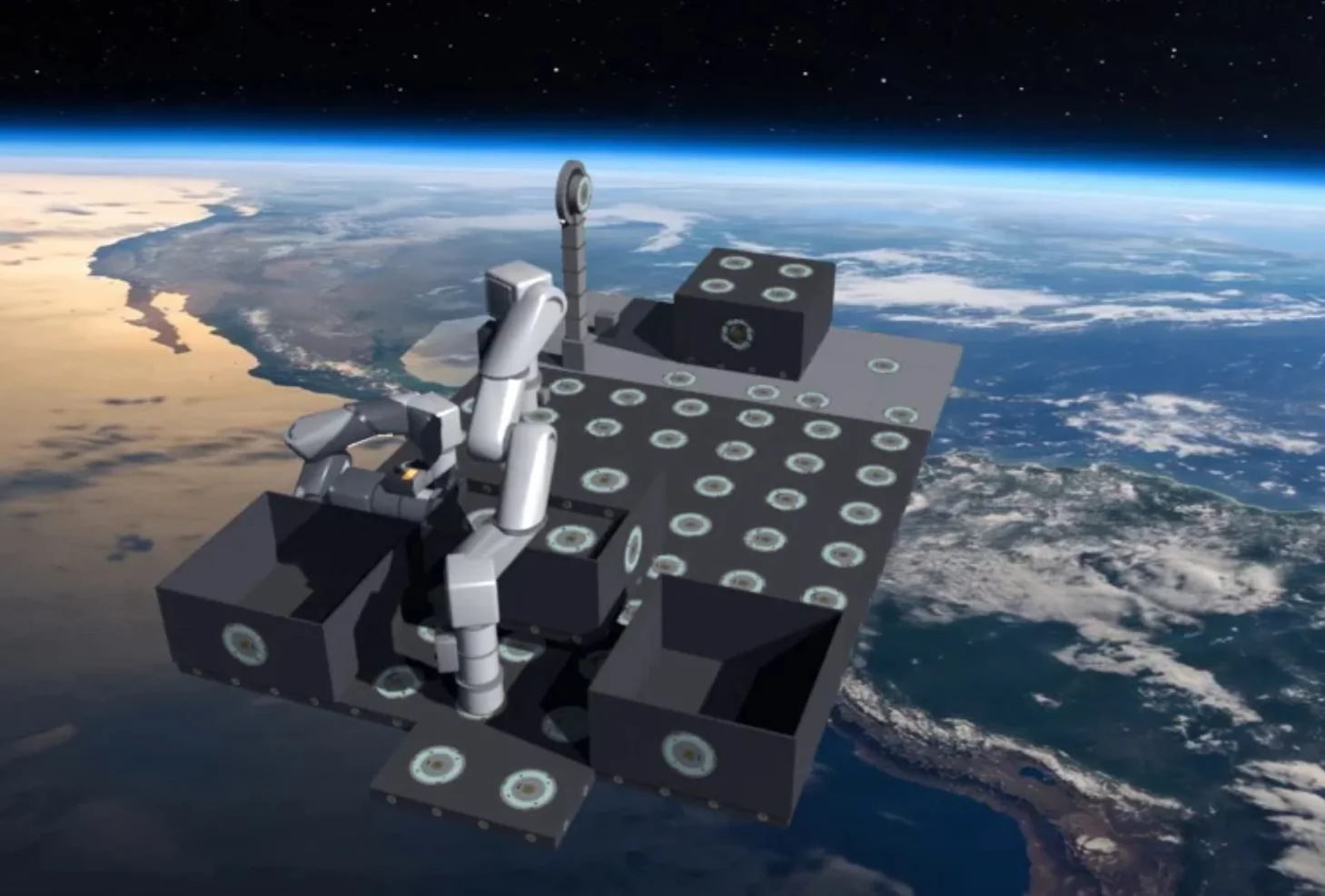
- Modular Elogium blocks launch as unassembled kits.
- One hermaphroditic coupling on every block: each half has both male and female load-bearing members.
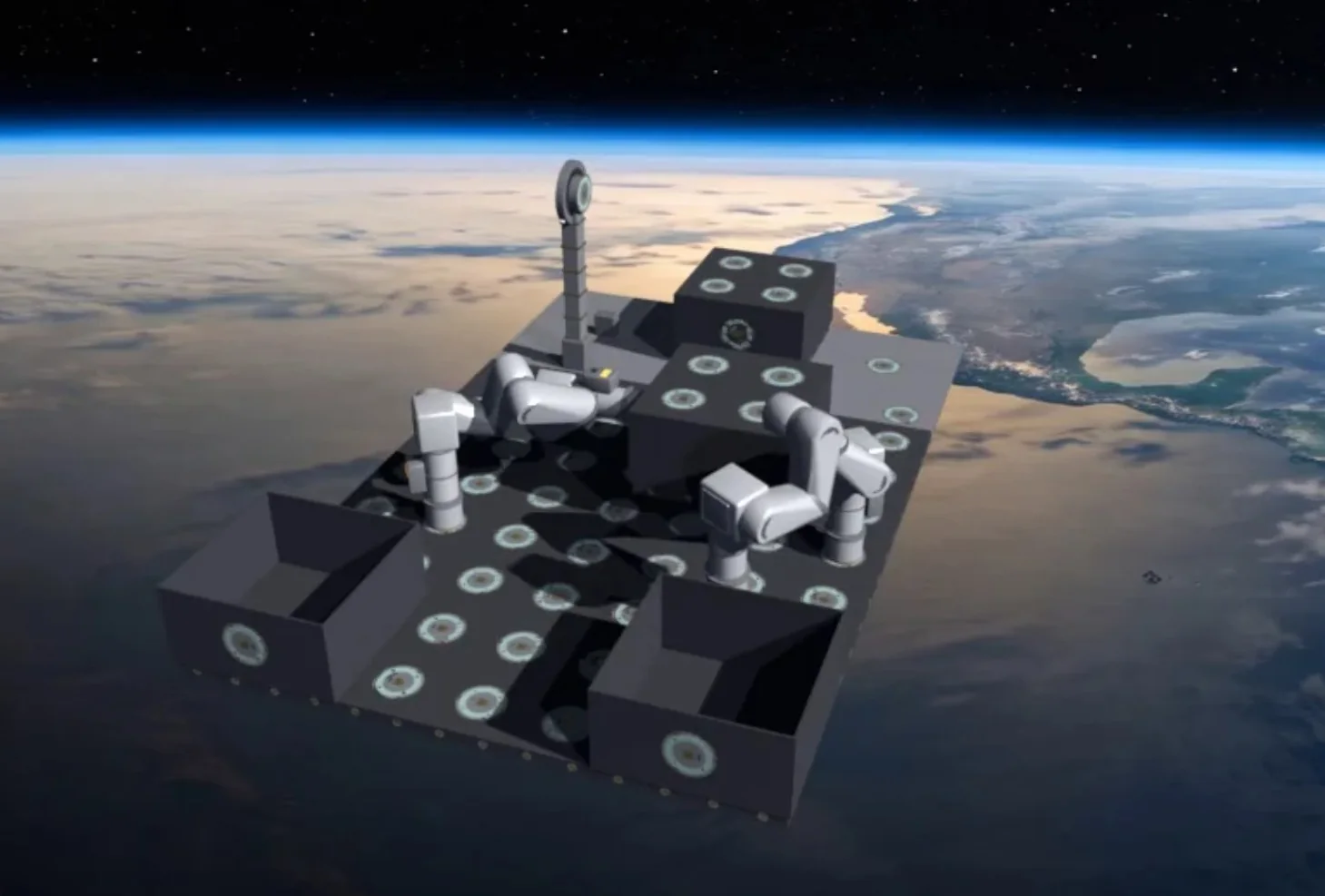
- Robots assemble the blocks in orbit, and the same blocks come apart and rebuild.
- Once producing, the station makes new blocks from its own harvest.
In development
Carbon nanotube gaskets seal the joints so the same kits build pressurized modules.
How it works
A farm and a refinery in one.
One harvest makes two products: biogas from the soft parts of the plant, and carbon fiber from the tough parts.
01
Resupply
Regular resupply brings up nitrogen and the other primitives the farm runs on.
02
Grow the plant
A fast-growing plant grows in a spinning centrifuge, fed by that nitrogen.
03
Make fuel
An anaerobic biorefinery turns the soft parts into methane and other biogas.
04
Make fiber
The tough, stringy parts become carbon fiber.
05
Build
The fiber is woven into Elogium and built into new blocks.
Station intelligence
The plan: our AI builds the station, then runs it.
Assembly
It directs the robots that put the kit together in orbit.
Operations
The plan is for it to run the station once it is producing.
It is two separate AI models working as a pair, in the manner of Holmes and Watson.
The launch case
Once Avalon is built, every launch carries more.
Every pound sent to orbit costs $1,475 to $3,175. Avalon cuts that for every mission that flies after it.
- They build with material from the station, so they don't launch their own structure.
- They resupply at Avalon, so they leave the ground with less fuel aboard.
A Moon mission that refuels at Avalon leaves the ground at about half the mass.
Business model
Two ways Novo Navis earns.
Leases
Station facilities rented to tenants at market rates.
- Drug manufacturing
- Research
- Advanced materials
- Warehousing
- Leisure
- And more
Supply
Ongoing sales of fuel and material in orbit.
$3,250–$7,000per kilogram to launch from Earth today. Station supply is priced below it.
Buyers: other stations and Moon and Mars programs.
Launch cost per kilogram from 2026 shared-ride and full-rocket prices.
Why now
Low orbit is opening for business.
The ISS is retiring
NASA plans to retire the International Space Station around 2030, and commercial stations are being built to follow it.
Investors are backing it
Vast alone has raised over $1 billion for its commercial stations.
Missions are heading outward
Moon and Mars programs need fuel and air that can be supplied from orbit.
Competition
Haven is static. Avalon reconfigures.
| Vast · Haven | Novo Navis · Avalon | |
|---|---|---|
| Reconfiguration | Static, fixed modules | Reconfigures in orbit, block by block |
| How it is built | Modules built on the ground | Kits assembled by robots in orbit |
| How it grows | Each new module is a launch | Makes new blocks from its harvest |
| Supply | Relies on suppliers for materials and compute | Makes its own material, fuel and compute |
| Stage | Haven-1 targeted for 2027; over $1B raised | Seed: Astra Porta™, test launch and robotic construction |
Provisional patent applications on file for the coupling, robotic assembly and the computational substrate.
Vast figures: Payload, January 2026; Via Satellite, March 2026.
Traction
Early traction and a public record.
Validation
“…has the potential to fundamentally change the way in which aircraft structure is designed and assembled.”
Air Force Research Laboratory, August 2020
Arizona State University’s AIMS Center signed on as research partner for our Phase II SBIR proposal, October 2020.
In discussions
Robotics: a robotic arm provider
Launch: a launch provider
The record
- 2020Elogium first woven in three directions
- 2020U.S. Air Force SBIR award, with 14 years left on its SBIR data rights
- Aug 2020CompositesWorld coverage draws interest from satellite and cycling companies
- Aug 2020Air Force Research Laboratory letter of support
- Jul 2026Elogium Reconfigurable Structural Kit
- Apr–Oct 2026Twelve provisional patent applications on file
- Aug–Oct 2026Four preprints with DOIs
- Oct 2026Astra Porta™ introduced
Roadmap
From the machine to the station.
01 · Funded by this raise
Build Astra Porta™
Design, fabrication and commissioning.
02 · Funded by this raise
First Elogium
Flight blocks made on Astra Porta™.
03 · Funded by this raise
Test launch and build
A robotic build of the kit in orbit. If it succeeds, it becomes the station nucleus.
04 · Next
Core and production
The core grows from the nucleus; cultivation, refining and fiber production come online.
05 · Next
Full operation
The hexagons and shipyards connect and open to tenants.
Team
Founder-built, from the material up.
Eric Scott Johnston
Founder and CEO
- Developed Elogium's three-direction weave in 2020.
- Designed Astra Porta™, the structural kit and its hermaphroditic coupling.
- Author of four preprints with DOIs.
- Background spanning physics, materials engineering, computing and law.
First hires
Funded by this raise
- Space systems engineer
- Materials scientist
- Process engineer
- Three technicians to run Astra Porta™ around the clock
The seed round
To build Astra Porta™ and fly the station nucleus.
Minimum check through the SPV, once the SPV is formed.
Minimum to come directly onto the Novo Navis, Inc. cap table.
Funds are released in tranches, on voted milestones.
What the round funds
Astra Porta™
Design, fabrication, commissioning and the first Elogium.
Facility and support
A production facility and the support to run it around the clock.
Team
Space systems, materials and process engineers, plus three technicians.
Launch and build
Transport and logistics to the launch provider, the launch, and the build that becomes the station nucleus.
The edge of imagination.
Novo Navis, Inc. · eric@novonavis.com · novonavis.com
Diligence and Data Room
For accredited investors, on request.
Tell us who you are and answer a short set of questions. We review each request.
Request access to the diligence and data roomNovo Navis, Inc. is offering securities under Rule 506(c) of Regulation D under the Securities Act of 1933. The securities are offered and sold only to accredited investors, as defined in Rule 501(a) of Regulation D, and the company takes reasonable steps to verify that each purchaser is an accredited investor before any sale.
The securities have not been registered under the Securities Act of 1933 or under any state securities law. They are offered under exemptions from registration, are subject to restrictions on transfer and resale, and may not be transferred or resold except as those laws permit. Neither the Securities and Exchange Commission nor any state securities regulator has approved or disapproved of the securities or passed on the accuracy or adequacy of this page.
This page is not an offer to sell or a solicitation of an offer to buy securities in any jurisdiction where that offer or solicitation is unlawful. Any sale is made only through the company’s definitive offering documents.
An investment in the company is speculative and involves a high degree of risk, including the loss of the entire investment. This page contains forward-looking statements about plans, costs, schedules and markets. They are estimates and goals, not guarantees, and actual results may differ from them.